
Pulice Summer Legal Intern Drew Schott brings a journalist’s curiosity and focus.
“Pressure is a privilege.”
The phrase, attributed to tennis great Billie Jean King, carries a simple idea: Pressure comes with opportunity. It means someone has earned the chance to perform when the work matters, when the stakes are real, and when preparation counts.
This is an ethos Drew Schott says he embraces.
As a Summer Legal Intern for Pulice – a FlatironDragados company, Drew has stepped into a fast-moving in-house legal environment where contracts, risk, compliance and construction law connect directly to heavy infrastructure projects across the Southwest.
“I would much rather be in a position where I have pressure and have to deal with pressure, and there’s a lot riding on something that I have to do, than not,” Drew said. “If you know what to do and you do it right, and you take the training and what you’ve learned, it’s very gratifying at the end.”
Drew is a rising second-year law student at Tulane University Law School and a Northwestern University graduate. Before law school, he built a foundation in journalism, including a sports department residency at The Arizona Republic and work covering national college football recruiting for On3 or On3 | Rivals.
His path to Pulice also brought him back to a familiar place. Drew’s family lives in Arizona, and he lived in the state full-time before law school while working in journalism and later attending Arizona State University’s Master of Sports Law and Business program at the Sandra Day O’Connor College of Law.
He knew the Pulice internship would offer him the kind of in-house legal exposure he wanted.
“I was looking for a company that would give me great in-house exposure and exposure to contracts, how legal teams analyze risk and how they deal with compliance matters,” Drew said.
Learning construction law one step at a time
Within his first few days, Drew was already working with purchase agreements, service agreements, subcontractor agreements, insurance issues, and legal research tied to construction operations.
He has also started learning the rhythm of legal review in a construction business, including how attorneys evaluate risk, revise terms and support project teams working in the field. For Drew, the value comes from seeing how legal work moves beyond theory and into decisions that affect real projects.
Construction law was not an area he knew deeply before the internship, but that is part of what drew him to the role. Heavy civil infrastructure brings complex agreements, demanding schedules, layered risk and coordination across owners, subcontractors, suppliers and project teams.
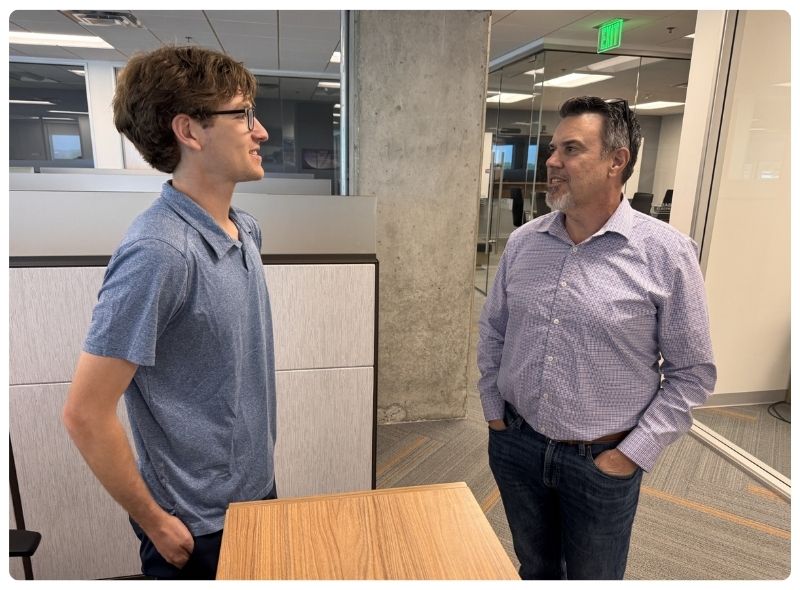
"I've been impressed by Drew's desire to learn and understand the nuanced aspects of the legal role within a construction business" said Pulice Corporate Counsel Todd Coleman. "He demonstrates quite a bit of energy and curiosity, which will serve him well in his internship with us."
“I love to learn, and I really love to learn by doing,” Drew said. “Being given the opportunity to do that here, and being given all the resources and support that I’ve received so far, has been amazing.”

Bridging sports journalism and legal analysis
Drew’s interest in law grew while he worked in sports journalism during a period of major change in college athletics. As college football recruiting became linked to issues tied to name, image and likeness, the transfer portal and what became the House v. NCAA settlement, he became increasingly interested in the legal and policy structures behind the stories.
That experience helped push him toward law school. It also gave him skills he now sees as directly relevant to legal work.
Journalism taught him to ask better questions, synthesize large amounts of information, write under deadline and maintain accuracy. Legal writing requires a different style, he said, but the discipline behind the work feels familiar.
“What journalism taught me is the ability to analyze large amounts of information at once and compress that into a memorandum, an email or a document that a supervising lawyer or member of the legal team needs to see,” Drew said. “The writing is different, but it still needs to be grammatically sound, clean and flow incredibly well.”
He also sees a shared responsibility between journalism and law: Both require clear answers supported by facts.
A place to grow
FlatironDragados has a broad commitment to developing legal talent and giving interns projects that matter.
“Mentorship is a fundamental part of developing as a young lawyer,” said Rachel Mockler, FlatironDragados Executive Vice President and General Counsel. “We provide interns with the opportunity to apply what they have learned in the classroom to real-world legal challenges, explore the dynamic field of construction law, and experience firsthand how rewarding—and enjoyable—an in-house legal career can be.”
Drew said he felt that commitment from his first day, when company leaders emphasized the importance of mentoring and developing interns. He has also found a team willing to answer questions, explain context and give him access to the agreements and information he needs to understand the work.
“Everybody here has been incredibly accessible and willing to talk, willing to introduce themselves and willing to answer questions,” Drew said. “I’m still learning and have a ton to learn, but it’s been great having the resources this company has been able to provide.”